
ISLAND RAID
August 2026-Fortnite Creative Level Demo
Genres: 1–2 Player, Third-Person Shooter, PvE Raid
Level Length: 30 mins
The video may take a moment to load. Please wait.
视频可能需要片刻加载,请稍候。
Infantry Gameplay Walkthrough (26:39)
SOFTWARE: UEFN, Project Graph
WORK: Level Design, Gameplay & Systems Design, Encounter Design, Verse Programming, Cinematics, Environment Art
3 Design Pillars
PLAYER AGENCY
Multiple viable approaches
KNOWLEDGE AS PROGRESSION
Map knowledge improves route efficiency
ESCALATING PRESSURE
Exploration → Combat → Resource Test → Time Pressure
Island Raid is a complete 1–2 player third-person PvE raid level built from the ground up in UEFN for Fortnite Creative. Players must complete a sequence of objectives before the timer expires while exploring the island, fighting enemies, collecting weapons, and planning efficient routes. The level supports multiple approaches, allowing players to progress on foot, with vehicles, or through a combination of both.
The project focuses on creating an exploration-driven raid experience within the gameplay and asset constraints of Fortnite. The level leads players from a low-elevation coastal airfield toward the island’s mountain summit, combining combat, exploration, resource discovery, and objective completion along the way. As players become familiar with buildings, supplies, and traversal options, they can gradually develop more efficient routes across repeated playthroughs.
You can also play the project yourself!
Step 1 — Join the Playtest Group:https://create.fortnite.com/join/8f5baa6f-24c8-4e16-9260-7993c4cc8709/023c38ea-f7f6-409e-81d8-439ff6d14f8d
Step 2 — Launch Fortnite Creative and enter the playtest code: 9452-3830-7053
DESIGN & DEVELOPMENT PROCESS
-GAMEPLAY & SYSTEMS DESIGN
-DESIGNING A RAID WITHIN UEFN CONSTRAINTS


-- Early concept & references
When I first started working with Fortnite Creative and UEFN, Fortnite’s destructible building system immediately reminded me of Battlefield. My original concept was a multiplayer PvP experience inspired by Battlefield’s Operations mode: defenders would use vehicles and mounted weapons from their bases to hold three regions of the island, while attackers could use vehicles and supply drops to push each objective.
The three planned phases centered on distinct combat scenarios: an airfield assault, urban combat through the town, and a final cliffside offensive. As the project evolved, however, both the level structure and the intended player experience changed significantly.
Gameplay & System Challenges:
During feasibility testing, I realized I couldn't test and iterate on a solo-developed PvP map efficiently without additional players. Fortnite’s existing AI and devices could replace much of the defending team’s behavior, but were poorly suited to acting as coordinated attackers.
I therefore reversed the structure: the player became the attacking force, while AI controlled the defense. This preserved the assault-focused experience I originally wanted while making the project practical to develop and iterate as a solo designer. The project was consequently redefined as a PvE raid.
Battlefield’s capture-point structure did not translate naturally into Fortnite’s PvE systems, so I replaced territory capture with destructible objectives. Destroying all objectives in a phase advances the raid, adds time to the countdown, moves the player respawn point forward, and updates the objective UI for the next phase. The first infantry-focused version gave players a fixed loadout, with ammunition inside buildings and supply drops outdoors. During iteration, I found that this gave players too little reason to explore the island. I therefore moved the loadout into the level itself: different buildings now contain fixed weapon spawns, some locations hide high-value rewards such as a tank, outdoor supply drops were reduced, and campfires became recovery points. This made exploration directly affect the player’s equipment, route planning, and combat efficiency rather than functioning as optional sightseeing. Vehicles created a second balancing problem. Once aircraft were introduced, destroying objectives became too easy. My first adjustment added defensive turret AI to the town and reduced aircraft durability, but the aircraft still remained too efficient. The second iteration gave defensive turrets an invulnerable shield that only drops after the player begins damaging an objective, while the objectives themselves were moved inside destructible structures. This increased the commitment and risk required for an air attack without removing aircraft as a viable strategy. Increasing turret fire rate made them threatening enough to aircraft, but also created excessive pressure for infantry players, who were more likely to avoid the turrets than engage them. To make combat a meaningful choice, destroying a turret now rewards the player with supplies. In Phase 3, eliminating the defensive turrets before the Boss encounter also triggers a powerful supply drop in the Boss arena, turning an optional combat risk into a strategic investment for the later fight.
This project taught me that designing within an existing game is not about using as many available systems as possible. UEFN provides a large library of devices, mechanics, and assets, and adding features without a clear purpose can quickly lead to unnecessary complexity.
My approach became to establish the minimum viable game loop first, then iterate around the most important problem in each phase. By solving the primary design constraint before adding secondary details, I could build the level from a clear framework instead of falling into an endless feature-and-polish loop.
With the core gameplay structure established, the next step was to translate these principles into the level itself—using terrain, routes, encounters, and spatial constraints to support the intended player experience.

LEVEL DESIGN

-- Final Level Structure Layout Overview

-- Level Flow, Design Goals, Player Experience & Pacing
-Terrain & Prefab Driven Blockout


--Early Sketches, Terrain & Graybox
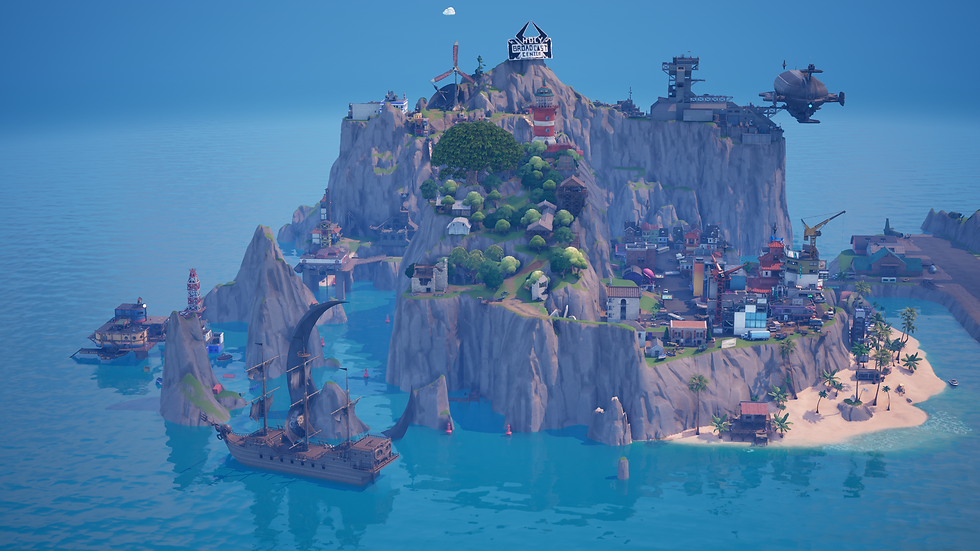
Based on my initial sketches, I divided the island into three major spatial regions: the Airfield, the Town & Hillside, and the Mountain Summit. The overall terrain rises progressively from the player spawn toward the summit, creating a stepped composition that gives players an early sense of direction while using elevation and terrain occlusion to hide later areas.
The summit serves as the level's primary landmark. As the layout evolved, I added secondary POIs near the airfield-facing slope and at the end of Phase 2 to pull players forward, gradually funneling their routes toward the suspension bridge leading to the final island.
Each region uses a different terrain profile to create contrast and support changes in gameplay pacing.
Airfield — wide, flat terrain with very few structures.
Town & Hillside — relatively flat and densely built on the front side, transitioning into steep cliffs and scattered structures toward the rear.
Mountain Summit — steeper and more vertically constrained, resulting in narrower playable spaces and more linear building placement.
This progression moves the level from an open and readable environment toward increasingly constrained and uncertain spaces as the raid approaches its climax.
I used landscape materials to reinforce the identity of each region and make primary routes easier to read:
Airfield — asphalt and stone transitioning into grass
Town — beach sand, large paved foundations, and grass
Hillside to Summit — grass, dirt, and rocky paths
The material progression supports the broader environmental transition from an organized, modern, stable starting area to a more rugged, abandoned, uncertain final region.
Because UEFN relies heavily on prefabricated building sets with fixed footprints, a traditional whitebox-to-final-asset replacement workflow would have created unnecessary rework. Instead, I used complete prefabs as spatial proxies during early layout.
I first treated each prefab as a simplified volume based on its overall footprint and silhouette, placed it according to its intended spatial function, and then searched the same asset set for compatible structures when I needed more variation.
This let me iterate on real gameplay dimensions from the start while still applying the same blockout principles: scale, spacing, sightlines, traversal, and spatial hierarchy.
AIRFIELD: Flat terrain with mostly low-profile structures, except for the control tower.
TOWN: Dense central buildings with greater height in the core and lower structures around the perimeter.
COAST: Steep terrain with taller standalone structures used as visual accents.
HILLSIDE: Buildings follow the slope, supported by bridges and smaller structures adapted to elevation changes.
SUMMIT — NORTH SLOPE: Limited but relatively gentle terrain with damaged small- and mid-sized structures.
SUMMIT — SOUTH SLOPE: Narrow, steep terrain dominated by large standalone structures.
For major POIs, I selected the airship and lighthouse because their silhouettes stand out immediately against the surrounding architecture.
To reinforce the summit as the level’s primary landmark, I placed a large billboard at the highest point of the island, keeping the destination visible from multiple earlier areas. With the main spatial hierarchy established, I moved on to designing the player routes between these locations.
-Route Design

Early Single-Route Layout

Final Multi-Route Layout
PROBLEM — A SINGLE ROUTE DID NOT SUPPORT PLAYER CHOICE
The early version of the level followed a single primary attack route. Players progressed along the same path while completing objectives, fighting enemies, exploring, and collecting resources before eventually reaching the summit.
Once aircraft and multiple vehicle types were introduced, this structure began to break down. A route designed for infantry did not naturally support ground vehicles or aerial approaches; traversal became repetitive, and large areas of the island remained unused.
The problem was structural, not something you could fix by adding more encounters to the same path.
DECISION — OPEN EARLY, NARROW LATER
I redesigned the level around multiple approaches that gradually converge as the raid progresses.
At the Airfield, players can enter the Town by launching themselves from a cannon, crossing the bridge, flying an aircraft, or approaching by boat. This increases the likelihood of exploring the areas around the Town and lets players start forming their preferred routes.
From there, the level gradually reduces the number of viable paths. A terrain bottleneck funnels players beneath the wooden bridge, while also preventing powerful early-game ground vehicles from entering later encounters and disrupting combat balance.
Phase 2 maintains separate land and sea routes, using terrain, occlusion, and architecture to guide both approaches toward the Lighthouse. The Lighthouse becomes the second major bottleneck, after which players cross the suspension bridge and enter the Summit.
WHY — CONTROLLED PLAYER AGENCY
The goal was not to maximize player choice at every moment. Early freedom encourages exploration and route planning, while gradually narrowing the available options reduces cognitive load and gives me tighter control over pacing and encounter composition later in the level.
RESULT — A MORE CONTROLLED FINAL ACT
The revised structure creates a clear shift from open exploration toward increasingly controlled progression. By the time players reach the Summit, the route has naturally transitioned from broad spatial choice into focused combat spaces.
After the Boss encounter, I used the remaining terrain for a short, high-speed final assault rather than extending the open exploration structure. A large standalone building allowed this final section to shift into an interior, mostly linear sequence, creating a different rhythm while maintaining the urgency established by the timer.
With the spatial flow established, the next question became: what should players actually be doing along these routes?

-Encounter & Pacing Design

-- Game Loop, Enemy Roles & Difficulty Variables

-- Player Resource & Supply Design
-- Level Flow, Design Goals, Player Experience & Pacing
The earliest playable version relied almost entirely on Ranged Infantry and Monster Spawners distributed evenly along the main routes. Players used a fixed loadout, while resources were limited to ammunition and supply drops.
This created combat that was simultaneously repetitive and overly demanding: enemies applied pressure everywhere, but encounters lacked distinct roles, priorities, and meaningful preparation.
I redesigned the encounter structure around three objectives per phase and concentrated enemy pressure around specific objectives and locations. Instead of spreading threats evenly across the map, each objective became a deliberate combat hotspot supported by multiple enemy archetypes.
This gave each phase a clearer combat identity while creating space between encounters for exploration, preparation, and route planning.


-- Phase1 Layout Samples
PHASE 1 — TOWN & BEACH
Each destructible objective is protected by a Defense Turret and two nearby Monster Spawners, creating a clearly defined high-pressure combat zone.
A smaller number of Ranged Infantry are placed around the beach and outer approaches. They serve as an early combat warm-up, foreshadow the pressure inside the Town, and provide a meaningful threat to players approaching with vehicles.
Road obstacles and structures break sightlines, create cover, and shape approach routes without forcing a single path. The respawn point remains at the Airfield, allowing players to reconsider their approach after death and encouraging experimentation with vehicles before later phases rely on them more heavily.
The three objectives went through several layout iterations. I wanted players to be able to attack the Town from multiple directions while keeping the main road as the most readable default route and difficulty baseline.
To do this, I placed all three objectives near the Town's perimeter and spaced them as far apart as possible. The first objective can be reached relatively easily from several approaches, but completing the remaining objectives naturally requires players to cross through the Town’s central combat space.
Players can avoid the center, but alternative routes come with tradeoffs: longer traversal, additional ranged threats, or fewer convenient supplies.
Phase 1 is intentionally forgiving enough for first-time players to explore without immediately building a large time advantage. Returning players, however, can use their knowledge of routes, weapons, and vehicles to complete the phase more efficiently and carry additional time into later encounters.
Phase 1 follows a simple resource rule: the farther players move away from the obvious route, the more valuable the potential reward.
All buildings contain basic weapons or ammunition, while less frequently visited areas such as the beach offer stronger options including machine guns, rocket launchers, and explosives. A hidden tank is placed inside an optional building as a high-value exploration reward.
Campfires are positioned near intersections and gathering points, while explosive barrels help players breach environmental obstacles. Mounted weapons around the Town provide effective tools against structures, enemy groups, and Defense Turrets, rewarding players who explore the perimeter rather than follow only the main road.
From the Airfield, players can enter the Town in several ways—launching themselves with a cannon, flying an aircraft, driving an armored vehicle, or taking a more traditional infantry route. These options establish player agency early and encourage experimentation before later phases begin testing those choices more aggressively.


- Phase1 Layout Samples
PHASE 2 — COAST & HILLSIDE
Phase 2 deliberately breaks the assumptions established in Phase 1.
All three destructible objectives are placed inside large offshore structures. Unlike the previous phase, no Defense Turret is visibly positioned directly above them, which initially suggests that close-range destruction may be safer.
However, concentrated Ranged Infantry fire makes direct swimming approaches extremely costly, while the offshore structures provide very limited supplies and no weapon spawns. The intended lesson is that the player should stop treating every objective as a close-range assault and begin using vehicles, mounted weapons, terrain, and long-range tools.
Because each objective is embedded inside a large destructible structure, raw damage alone can make destruction slow and inefficient. I therefore placed explosive props at selected structural weak points.
These weak points are intentionally visible from useful attack positions—such as mounted weapon locations—or positioned along side and rear approaches that reward players who use vehicles or explore alternative firing angles.
This makes observation and positioning part of the destruction puzzle, rather than making the encounter depend purely on damage output.
The phase is balanced around approximately five minutes per objective. First-time players may spend most of that time discovering viable attack methods, while experienced players can convert route knowledge and preparation into a meaningful time surplus for later phases.
Based on the new respawn point, I expected four primary approaches to become the most common ways to complete this phase:
-
Attack with the aircraft
-
Attack with a missile boat
-
Use mounted weapons on the hillside, such as cannons and machine guns
-
Destroy the objectives with collected long-range weapons, including rocket launchers
By differentiating these approaches through level layout and numerical balancing, I wanted each option to offer a distinct risk–reward profile and gameplay experience:
Aircraft
High Risk · High Skill · High Reward
Missile Boat
Medium Risk · Medium Skill · Medium Reward
Infantry / Mounted Weapons
Lower Risk · Exploration & Positioning Required
Aircraft and missile boats initially had too much durability and could destroy objectives too efficiently. After reducing vehicle durability, concentrated infantry fire around each objective became an effective attrition pressure: vehicles could usually destroy only one or two structures before becoming vulnerable.
The aircraft offers the highest efficiency, but there is only one, and it cannot be repaired, making it the highest-risk option. The missile boat is slower and has a lower fire rate, but can recover durability near campfires, giving it more sustain at the cost of speed.
Buoys distinguish safer navigation lanes from exposed open-water routes. Enemy placement creates heavier pressure near cliffs and the outer sea, while narrow channels offer lower-pressure traversal options.
Infantry players take a slower but more reliable approach. Terrain occlusion prevents players from attacking every objective directly from the respawn point, forcing them to move through the Hillside to find effective firing angles.
The route passes through a major tree POI and naturally introduces encounters with groups of melee wildlife. Narrow terrain, frequent occlusion, and short sightlines shift the combat rhythm toward close- and mid-range encounters, balancing the relative safety of the infantry approach with additional traversal and combat costs.
Side paths and hillside buildings provide rocket launchers, long-range weapons, and ammunition needed for objective destruction. However, high-powered close-range weapons are intentionally scarce in this phase, rewarding players who preserved suitable weapons from Phase 1.
At the end of Phase 2, the sea and hillside routes converge at the Lighthouse, which functions as both a POI and the level’s second major bottleneck.
Its elevation gives players a clear view of the upcoming terrain and enemy placement. A zipline near the cliff quickly reconnects players arriving from the sea route with the Lighthouse area.
The camp and structures near the final objective visually echo the abandoned camp used in Phase 3, giving players an early preview of the next environment before they cross the suspension bridge to the Summit.


- Phase3 Layout Samples
PHASE 3 — SUMMIT: NORTH SLOPE
Phase 3 no longer uses destructible objectives. Instead, players discover that destroying the objectives in the previous phase has disabled the invulnerable shields protecting the three Defense Turrets on the suspension bridge and summit camp. This resolves a rule introduced earlier and reinforces consistency in how the level’s systems behave.
The abandoned summit camp continues the encounter language introduced at the end of Phase 2. Players must move through the camp on foot, fighting infantry and the remaining Defense Turrets before reaching the Boss arena.
Destroying all three turrets rewards the player with an additional high-value supply drop during the Boss fight, turning an optional combat challenge into preparation for the upcoming encounter. A respawn point is placed near the arena so that death does not force players to repeat a long traversal and interrupt the pacing.
This phase functions as a resource and damage-output check. Ammunition becomes noticeably less common, encouraging players to rely on weapons and resources accumulated earlier in the raid. Basic weapons remain available as a fallback, ensuring that running low on resources does not completely block progression.
I used the negative space created by ruined buildings to visually enclose the arena and foreshadow the Boss encounter before the player fully enters it. Rocks placed along the main route prevent players from bypassing the summit camp, ensuring a short infantry encounter before the Boss fight begins.
Exploration remains valuable even during this high-pressure phase. Ruined buildings contain ammunition, high-damage weapons, and mounted weapons that can significantly increase the player’s effectiveness against the Boss.
Players who investigate the second floor of the white research facility can even discover a tank as an optional high-value reward. The goal is to let well-prepared or highly exploratory players fully capitalize on everything they have learned and collected before entering the Boss fight.
Unlike previous objectives, defeating the Boss does not grant additional time. As a result, players usually enter Phase 4 with roughly five minutes remaining and a distant, uncertain destination ahead.
This intentionally shifts the source of pressure. The Boss encounter focuses on combat and resource pressure; immediately afterward, the challenge becomes traversal speed and uncertainty about the remaining distance.
Multiple ziplines around the ruined buildings speed up the climb toward the summit and reinforce the shift from combat to rapid movement.
Because the player has just completed a major combat challenge, I added a short reward beat before the final phase.
Behind the summit billboard, players can detonate explosives that release a massive boulder. The boulder rolls downhill, clears obstacles, and crashes through the entrance of the airship base.
A short cinematic makes the event clearly visible, rewards the player with a strong spectacle, reveals the next destination, and transitions them directly into the beginning of Phase 4.
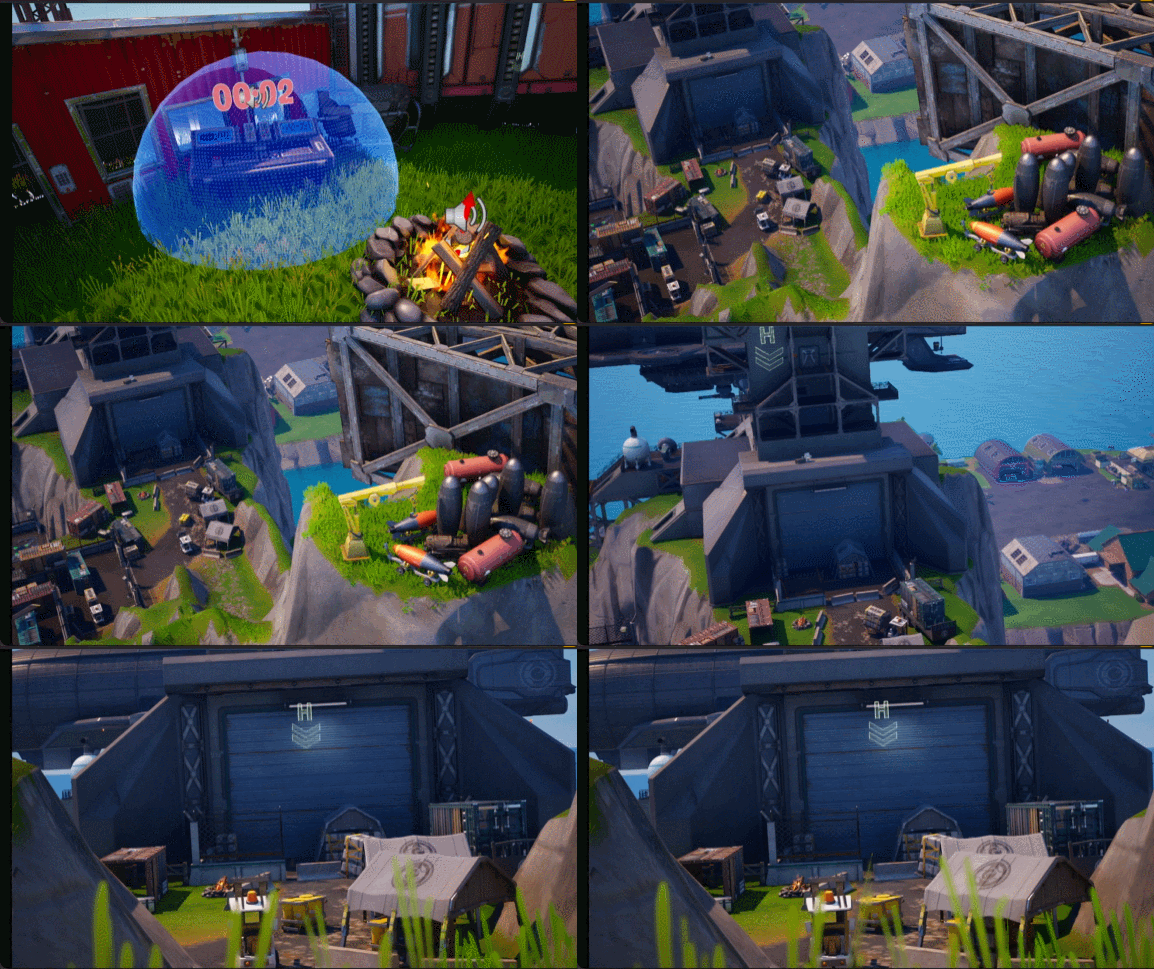
-- Sequencer Setup in UEFN
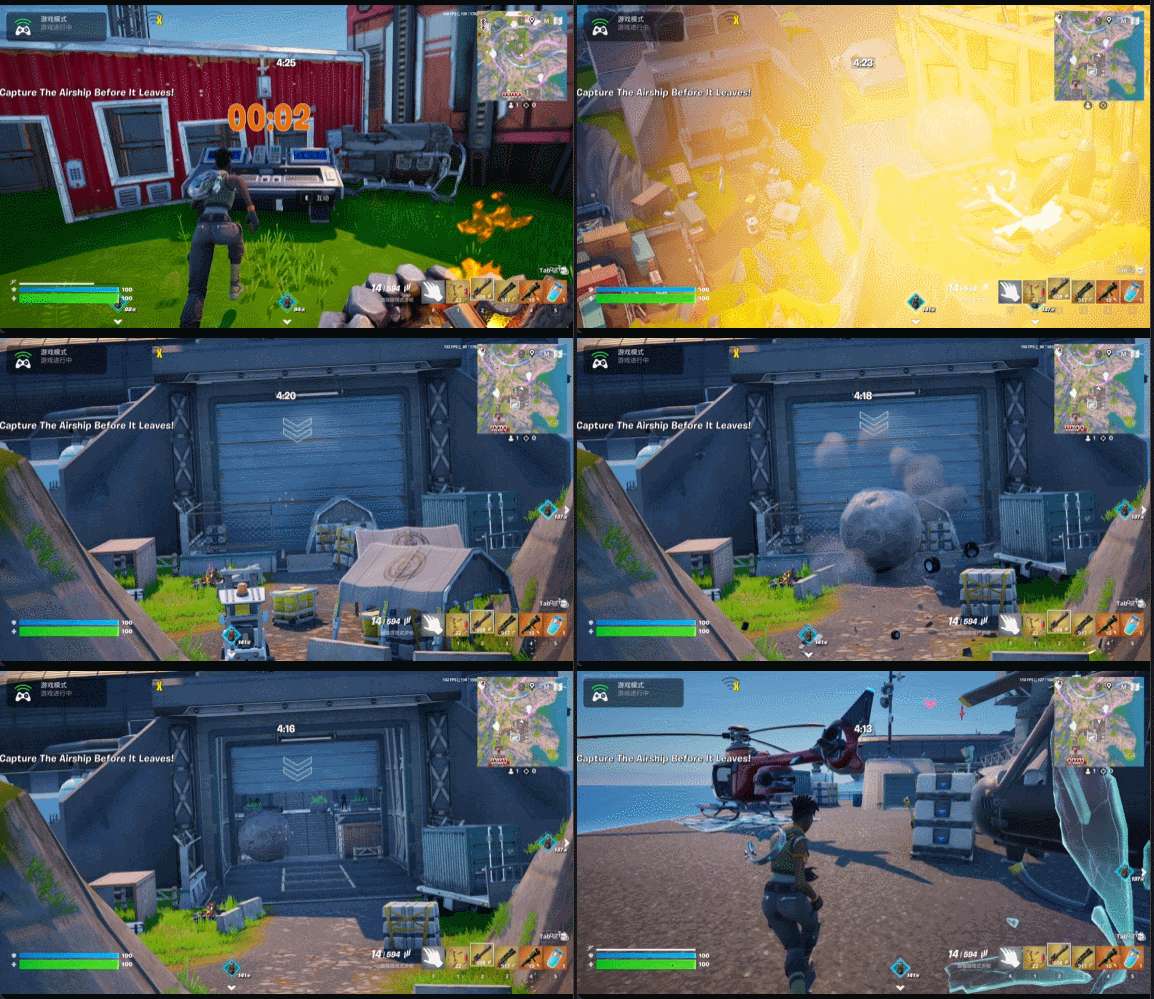
-- Boulder Sequence In-Game Result
PHASE 4 — SUMMIT: SOUTH SLOPE
Several elements were designed to keep the Airship Base intimidating and uncertain before Phase 4 begins:
1. Limited Access — The Airship Base is the only completely indestructible major structure in the level. Its exterior doors cannot be opened early, preventing players from scouting the interior before the final phase.
2. Perceived Distance — Reaching the airship from the Boss arena requires traveling across a large portion of the Summit, making the destination feel physically distant.
3. Strong Defensive Presence — The base is surrounded by a high concentration of enemies and the strongest anti-vehicle Defense Turret in the level, which remains invulnerable before Phase 4.
4. Reinforced Entrance — Before the boulder sequence, the main entrance has 7,000 health—more than the Boss’s 5,000—and player structure damage is reduced to 75% of standard Fortnite values. This discourages players from forcing entry early.
5. Visual Scale — Multiple assets are combined to create a tall, elongated base silhouette, giving the final structure a stronger sense of scale and visual pressure.


- Phase4 Layout Samples
After the boulder breaks through the entrance, the player is moved to a small staging area beside the gate. Supplies are intentionally limited, but an optional button-controlled room contains weapons as a reward. This introduces the button interaction before the same mechanic becomes necessary later in the base.
Following the boulder’s path, the encounter shifts from outdoor combat into a compact indoor third-person shooter sequence. I modified the original prefab interior by blocking unused rooms, repositioning doors and windows, and using button interactions and Sequencer-controlled elements to create a focused route lasting roughly three minutes.
The player can move quickly through the space by clearing enemies and following the main route, or briefly explore side areas for stronger equipment such as a rocket launcher, explosive sniper rifle, and high-tier assault rifle. Only one room provides a campfire and ammunition, keeping the overall pacing focused on forward movement rather than extended exploration.
Activating the final button opens the last door and removes the Defense Turret’s invulnerability. With only one or two minutes remaining, the player must clear the final outdoor corridor, defeat the turret, and push toward the airship.
The turret’s knockback effect creates the final movement obstacle, actively preventing the player from simply running past the encounter. Reaching the final trigger completes the raid: the player captures the airship, the victory cinematic plays, and the game ends.
-Alternative Solution
-- Vehicle Speedrun 08:10(2× Playback)
Because Phases 1 and 2 preserve a high degree of route freedom, experienced players can combine their knowledge of vehicles, resource locations, and objective rules to develop faster strategies.
This video demonstrates one possible vehicle-focused route that completes the raid significantly faster. It is not intended as the single optimal solution—the level is designed to let players combine their understanding of the map and systems to develop their own approaches.

BEYOND LEVEL DESIGN
-Cinematic Design & Sequencer
Opening Cinematic — Created in UEFN
Cinematic:
I created a short opening cinematic in Sequencer to establish a simple motivation for the raid. Inspired by the pacing and tone of the Flexair short-film series, I developed my own storyboard in which the airship shoots down the player’s aircraft, establishing it as the primary antagonist and giving the player a clear reason to attack the island.
The ending cinematic closes this loop by showing the player successfully capturing the airship. From a level-design perspective, introducing the airship at the beginning also turns it into a long-term visual hook, making it clear that the Boss encounter is not the true end of the level.
Sequencer also drives gameplay transitions, including the summit boulder sequence and several doors inside the Airship Base. During implementation, I found that streaming distance and playback limitations could cause differences between editor previews and actual gameplay. This taught me to account for render distance, frame rate, and platform performance when planning camera shots and moving objects.


Gymnasium & Verse Implementation
Programming :
A central Verse device manages phase activation, beacons, UI updates, timers, and the raid's overall progression logic.
To speed up debugging, I built a small Gymnasium specifically for testing the phase-management system. Isolating the logic from the full island significantly reduced iteration time and made it easier to verify objective activation, UI behavior, timers, and phase transitions.
The phase system prevents players from activating later objectives before completing the current phase, preserving progression while still allowing freedom within each active area. The dynamic timer also links objective completion directly to remaining time, increasing urgency and encouraging players to refine their routes and decisions after unsuccessful attempts.


-Environmental Art Samples
Environment Art:
For the environmental storytelling, I intentionally used different architectural styles across different areas to distinguish each region and make the environment fit its location. Fundamentally, I made these visual choices to serve the level design.
For example, the contrast between the modern Town and the ruined Hillside buildings helps players feel the transition between regions. In Phase 2, I used pirate-themed architecture for all three objectives to visually connect them. The final objective also begins to share the Summit's ruined visual language, implying that the pirate faction once occupied the island's abandoned areas.
Around the Boss arena, I placed a relatively intact research facility among the surrounding ruins, suggesting that the Boss may have been the result of an experiment that went out of control and destroyed the settlement on the north side of the Summit. The explosives beside the large boulder also suggest that the pirate faction had prepared them as part of an attack against the Airship Base.
For the Airfield and Town, I intentionally created a vacation-town feel so players could feel excited and relatively relaxed before entering the main combat areas.
I also placed the palm trees on the beach based on level-design needs. Powerful weapons placed on the beach were initially too easy for players to spot, so adding trees made those rewards less immediately visible. The trees also make it more difficult for players to eliminate enemies on the beach too early by using the coastal artillery from the base.
On the Hillside, trees are used to create more close- and mid-range encounters while blocking the player's sightlines and preventing the route from becoming readable too early. The vegetation also creates a clear visual contrast with the urban environment of the previous area.
In addition, I manually placed and adjusted smaller environmental setups to provide guidance, support environmental storytelling, and create small points of interest or functional spaces along the route. I placed vehicles, gameplay functions, and weapons within these areas to reward players for exploring, while also allowing supplies to feel more naturally integrated into the overall environment.


- Smaller environmental setups


-Weapon placement
Weapon Selection & Placement:
UEFN offers thousands of weapons and items, so I used the same framework-based approach when designing the weapon pool: if a weapon wasn't necessary, I didn't add it.
I first identified the necessary weapon categories based on the encounter design and overall game flow. Explosives and rocket launchers are used to damage groups of enemies and destroy structures. Melee and close- to mid-range weapons are mainly used during the Hillside phase. Weapons with high sustained damage are useful during the Boss fight. Long-range weapons help players scout ahead and accurately hit the explosive barrels in Phase 2, while rifles are effective against Ranged Infantry at medium and long distances.
I also added an Easter egg weapon that can destroy an entire building in a single shot. I hid this weapon type in remote areas of the map as a reward for players who explore and discover it.
For weapon selection, I limited each category to around four or five options. When weapons within the same category mainly differed in numerical values, I tested and ranked them based on ease of use, feel, and overall effectiveness into three tiers: top-tier, strong, and standard.
For example, with machine guns and rifles, I placed standard options in frequently visited areas, stronger options in areas that require some exploration, and the highest-value options along unconventional routes.
For weapons that differ mechanically—such as rocket launchers, where some can be guided while others are fire-and-forget—I evaluated the gameplay experience first, then ranked and placed them according to the same principles.
RETROSPECTIVE & TAKEAWAYS
1. PLAYER FREEDOM NEEDS STRUCTURE.
This project taught me that multiple routes do not mean always giving players the maximum number of choices. Open routes early in the level encourage exploration and route planning, while gradually narrowing those choices as the level progresses helps control information, pacing, and encounter intensity.
Player freedom and guidance are not opposites; they need to be adjusted dynamically depending on where the player is in the experience.
2. UNDERSTANDING THE LEVEL CAN BECOME A FORM OF PROGRESSION
The project does not rely primarily on traditional numerical upgrades for progression. Instead, the spatial distribution of weapons, vehicles, supplies, firing angles, and hidden routes lets players gradually build map knowledge through repeated play.
The first playthrough focuses more on exploration and reacting to situations, while players familiar with the level can plan routes, evaluate risk and reward, and significantly reduce completion time.
3. PRODUCTION CONSTRAINTS ARE ALSO DESIGN CONSTRAINTS
From changing the project from PvP to PvE, to adapting my blockout workflow around UEFN prefabs, and using an independent Gymnasium to debug Verse, I increasingly realized that level design is not only about proposing an ideal solution. It is also about finding the most effective way to implement that solution within the constraints of the engine, assets, time, and available testing conditions.
NEXT ITERATION
NO LEVEL IS EVER PERFECT
If I Continue Developing the Project, I Would Prioritize Testing:
1. Co-op Mechanics & Current Balance
The current 1–2 player version shares the same core progression for solo and co-op play, and most of my testing has been done with a single player. The next step is to further test enemy counts, resource consumption, and task distribution with two players, so co-op gameplay becomes more than simply “adding another player.”
2. More Playtest Samples Across Different Skill Levels
I would increase the number of playtesters with different skill levels and record phase completion times, death locations, route choices, and equipment selections. This data could then be used to further evaluate the route and resource design.
3. Improve Sequencer Presentation
I would further improve the Sequencer cinematics based on viewing distances across platforms, especially by adjusting the opening cinematic so it remains readable on lower-end devices.
I would also add new cinematics during phase transitions to communicate more clearly that the player has completed the current phase, and potentially add failure cinematics to motivate players to try the level again.